
Solution / Customer Experience
Understand the experience. Improve what matters.
Get closer to your customers’ needs, expectations and real experiences to create better journeys, stronger relationships and more confident decisions.

What we help with
Turn customer understanding into better experiences.
We help uncover what really drives customer experience, from needs and expectations to the moments that matter most. The result is a clearer view of what to improve, where to focus and how to deliver meaningful change.
Customer needs & expectations
Understand what customers really want, need and value at every stage.
Journey experience
See the experience through customers’ eyes to identify what’s working and what’s not.
Experience performance
Measure what matters, from satisfaction and effort to loyalty and advocacy.
Prioritisation & action
Turn insight into a focused plan that improves experiences and delivers impact.
Our point of view
Better experiences start with a clearer view of what people go through, and what they need next.
Improvements should be rooted in real behaviours, barriers and expectations, not assumptions.
Free practical toolkit
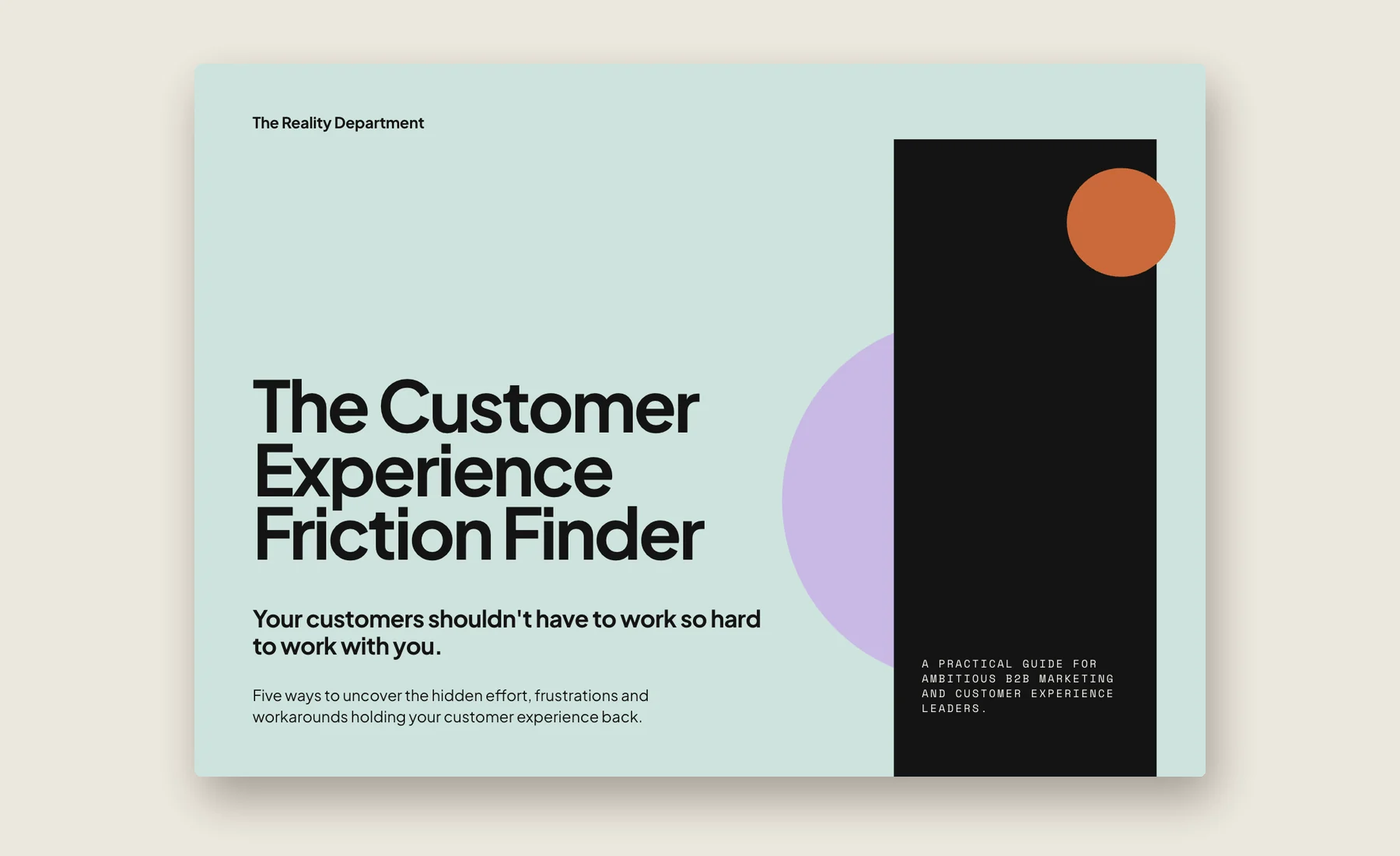
The Customer Friction Finder
A practical guide to help you identify, understand and prioritise the moments in your customer journey that matter most. It includes a journey audit, a friction assessment and a prioritisation matrix.
Case study
Hearing the customers standard research shut out.
A financial services brand wanted to serve deaf, hard of hearing and non-speaking customers better. An accessible research method changed how it communicates, with +35 NPS within the same group at the next wave.
Insight Activation
Turn CX insight into meaningful change.
Move from customer feedback to clear actions that improve experience.
See Insight Activation →Experience briefings
Journey opportunities
Action plans
Ongoing measurement
FAQs
Common questions about customer experience research.
We run customer experience research for consumer and B2B organisations, adapting who we speak to and how to the way your customers actually buy and use what you offer.
What does a customer experience research study include?
It depends on the decisions you need to make. A study might map the end-to-end journey, explore needs and expectations through interviews or groups, measure satisfaction, effort and loyalty through a survey, and pinpoint the moments where customers struggle or drop away. For B2B, that often means hearing from several people involved in a relationship, not just one contact. For consumers, it can mean reaching groups that standard methods miss. The output is a clear view of what’s working, what isn’t and where to focus first.
How is this different from customer satisfaction research?
Satisfaction research tells you how people rate an experience. Customer experience research goes further: it looks at the whole journey, what people expect at each stage, where friction appears and why it matters to them. Satisfaction scores can be part of it, but on their own they rarely show what to change. CX research connects the scores to the moments and reasons behind them, so you can see which improvements are likely to matter most.
How do you prioritise which issues to focus on?
We look at how often an issue occurs, how much it affects customers and how closely it links to the outcomes you care about, such as loyalty, retention or advocacy. We also weigh how practical it is for your organisation to fix. That usually produces a short list of priorities rather than a long list of problems, so teams can agree where to start. The decision on what to act on stays with you. Our job is to make the evidence clear.
Can you work with our existing CX or Voice of Customer programme?
Yes. We can review what your current programme measures, how the data is used and where the gaps are, then design research that adds depth rather than duplicating it. That might mean qualitative work to explain what the scores are showing, or a focused study on a part of the journey your programme doesn’t cover well. We’ll confirm access to existing data and the scope of the work when we first discuss it.