
Solution / Market Understanding & Opportunity
See the opportunity before everyone else does.
Get a clearer view of your market, customers and competitive landscape to spot opportunity, reduce risk and make more confident decisions.

What we help with
Turn market insight into real opportunity.
We help you understand what’s happening in your market, where it’s heading and where the most credible opportunities lie. The result is a clearer view of where to focus, how to compete and how to grow.
Market dynamics
Understand the forces shaping your market today and what’s likely to change.
Customer & segment insight
Uncover needs, behaviours and unmet opportunities across today’s and tomorrow’s customers.
Competitive landscape
See where you’re positioned, how you compare and where you can credibly win.
Opportunity prioritisation
Turn insight into a focused set of opportunities, with clear rationale and next steps.
Our point of view
Opportunity is rarely obvious. It’s uncovered.
The best opportunities come from a deeper understanding of customers, context and change, not just bigger data sets.
Free practical toolkit
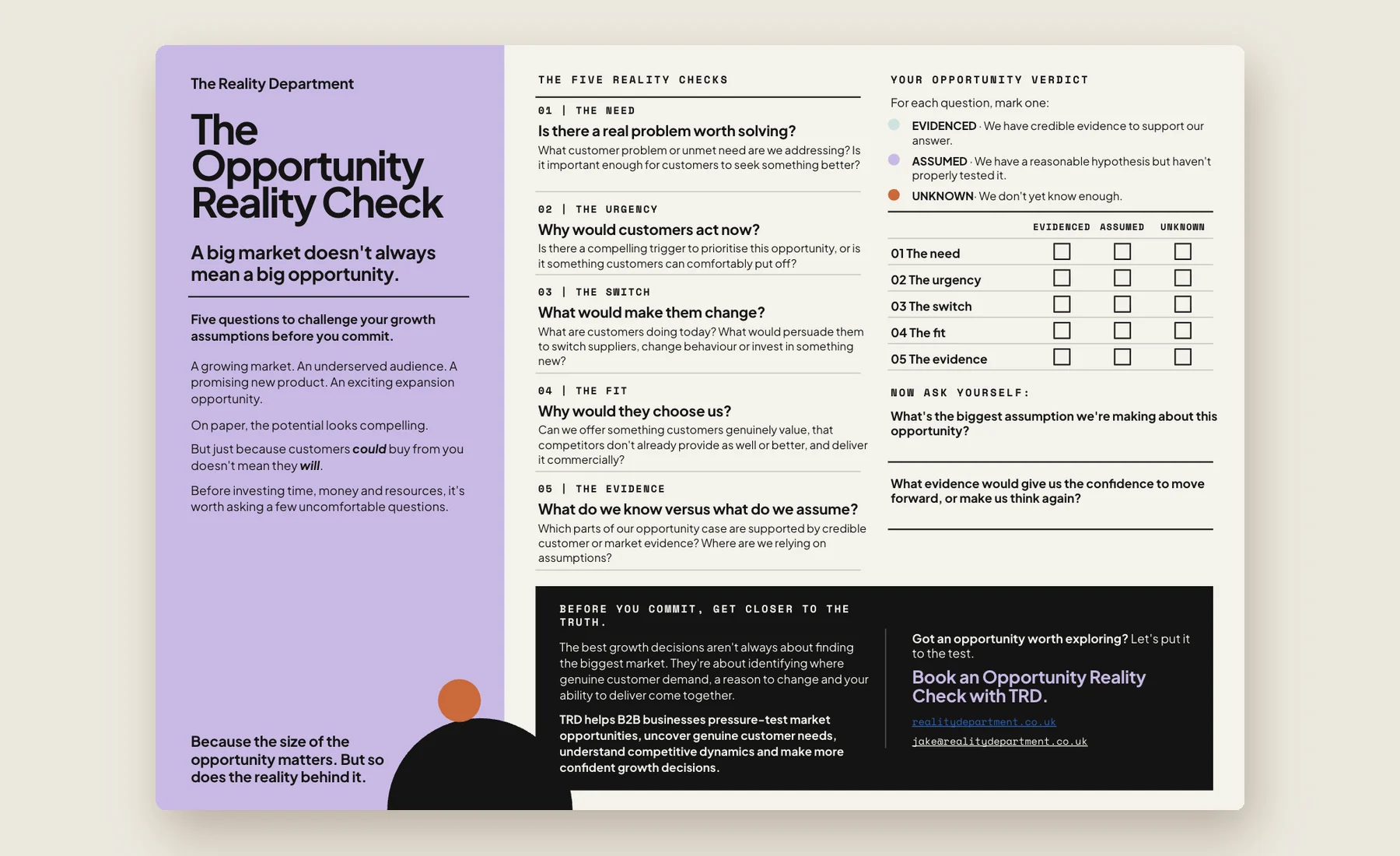
The Opportunity Reality Check
A practical framework to help you assess market potential, pressure-test opportunities and prioritise where to focus for the greatest impact. It includes five reality checks, an opportunity verdict grid and two questions to ask before you commit.
Evidence in action
Testing a new market before spending on it.
A finance accounting tool was preparing to enter a new market. Qualitative and quantitative research with its target audience showed what would really make them switch, and tested the campaign before launch. It helped drive sales from the first month.

Insight Activation
From market insight to a clear plan.
We turn market understanding into practical outputs that inform decisions and drive action.
See Insight Activation →Opportunity briefings
Strategic options
Prioritised opportunities
Evidence for investment
FAQs
Common questions about market opportunity research.
We run market understanding research for consumer and B2B organisations, shaping the approach around the growth decision you’re facing.
What does a market opportunity assessment involve?
It starts with the decision you need to make. We then look at the market landscape, what customers need and aren’t getting, how competitors are positioned and what signals there are of real demand. Depending on the brief, that can combine desk research, stakeholder interviews, customer interviews and surveys. The scope depends on how much is already known and how big the decision is. The output is a clear view of where the opportunity is, how strong the evidence behind it is and what’s still uncertain.
How is this different from a traditional market research project?
Traditional market research often describes a market: its size, its players and its customers. An opportunity assessment is organised around a growth decision, such as whether to enter a market, launch a proposition or target a new segment. It still uses established qualitative and quantitative methods, but every question is there to inform that decision. That keeps the work focused and makes the findings easier to act on.
Can you help us prioritise which opportunities to pursue?
Yes. We assess each opportunity on the evidence: how attractive it is, how much customers value it, how crowded the competition is, how well it fits your strategy and capabilities, and what remains uncertain. That usually narrows a long list down to a few options with a clear rationale behind each. The final call stays with you. Our job is to make the trade-offs visible and show where more evidence would change the answer.
Do you work in specific markets or sectors?
We’re sector-agnostic. The approach is shaped by the business question rather than the industry, and we work with both consumer and B2B organisations. Our published case studies include market entry research for a finance software provider and broker research in insurance. If your market has specialist audiences that are hard to reach, we’ll talk through how we’d reach them when we first discuss the brief.